A constituent named Stanley Bernstein recently asked a question on Facebook that deserves a clear and factual answer:
Are more buses more important than water, jobs or reliable electricity?
The answer is found by following the public record and tracing what happened to a voter-approved sales tax originally dedicated to protecting the Edwards Aquifer.
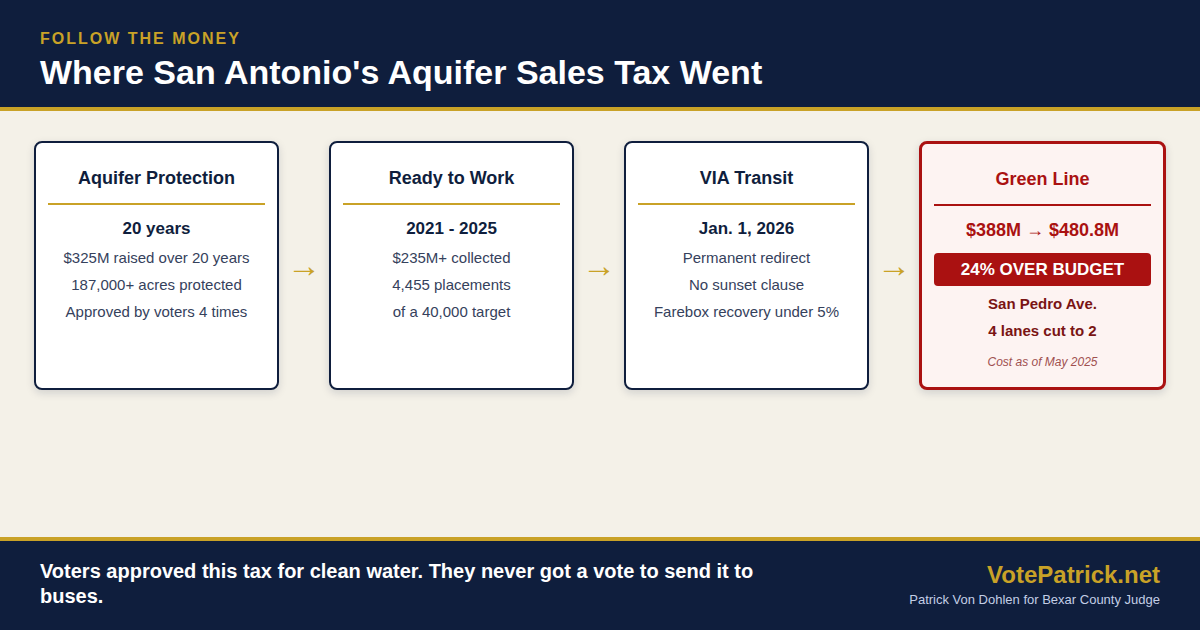
For 20 years, Bexar County voters repeatedly supported using a one-eighth-cent sales tax for the Edwards Aquifer Protection Program. The program raised more than $325 million and helped protect approximately 187,000 acres across roughly 160 properties through conservation easements and direct land purchases.
Those investments were intended to safeguard the drinking-water supply relied upon by San Antonio and surrounding communities.
The Sales Tax Was Redirected
In December 2018, then-Mayor Ron Nirenberg proposed redirecting the aquifer sales tax to VIA Metropolitan Transit.
Nirenberg and then-Bexar County Judge Nelson Wolff had formed ConnectSA to develop a regional transportation expansion plan. That plan identified the aquifer sales tax as a potential long-term funding source.
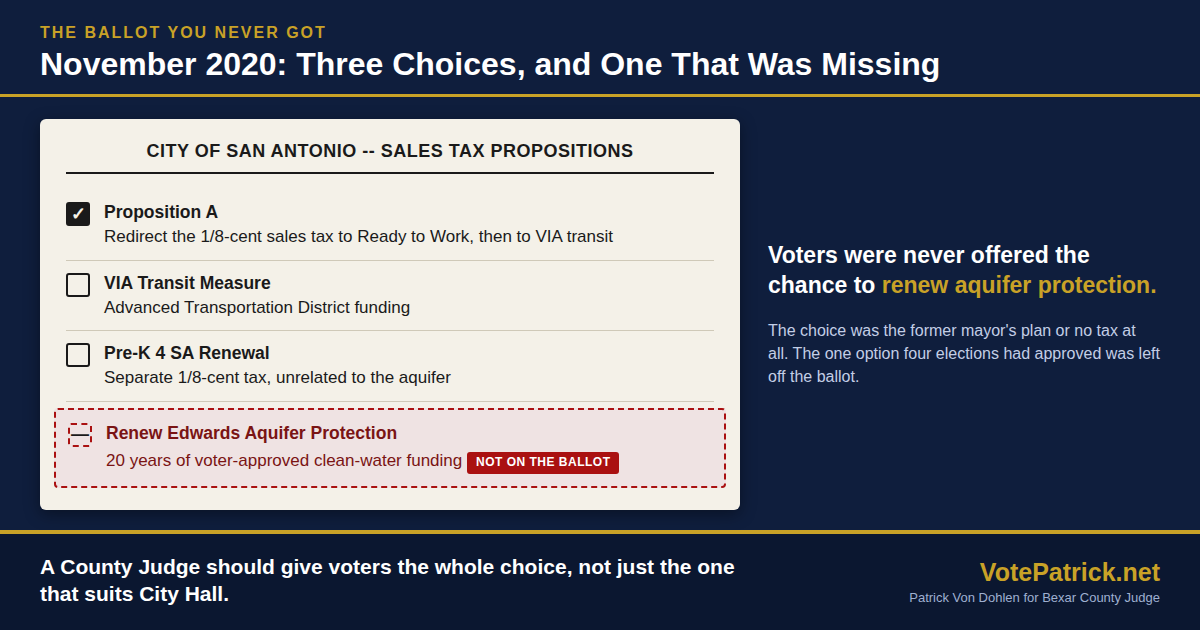
After other alternatives failed to advance, the proposal was repackaged for the November 2020 ballot.
Voters were presented with the Ready to Work workforce-development program, funded from 2021 through the end of 2025. Once that collection period ended, the same sales tax was scheduled to move permanently to VIA’s Advanced Transportation District beginning January 1, 2026.
What voters were not offered was an option to renew the Edwards Aquifer Protection Program.
The absence of an aquifer-renewal option was not accidental. It was a structural decision made before the election.
Borrowing Replaced Voter-Approved Funding
On September 17, 2020—approximately seven weeks before the election—the San Antonio City Council voted 9-2 to establish a replacement funding structure for the aquifer program.
The plan authorized the San Antonio Municipal Facilities Corporation to provide up to $100 million for continued land acquisition. That stated amount excluded interest, financing expenses and operating costs.
Councilmembers Roberto Treviño and Clayton Perry, who represented very different portions of the political spectrum, voted against moving forward at that time.
Both asked the council to wait until voters decided the Ready to Work proposition. Had voters rejected it, the sales tax could potentially have been reconsidered for continued aquifer protection.
Instead, the replacement structure was approved before voters went to the polls.
The result was a fundamental change:
- A voter-approved, pay-as-you-go conservation program was discontinued.
- Its replacement became dependent on borrowing and annual council decisions.
- The debt associated with the replacement structure is scheduled to extend decades beyond the land-acquisition period.
San Antonio replaced a voter-approved conservation funding stream with long-term borrowing—without placing the replacement aquifer plan before voters.
Two Programs, Two Very Different Standards
The contrast becomes clearer when the aquifer program is compared with the Linear Creekway Parks program.
The creekway program also lost funding associated with the expiring sales-tax arrangement. However, it later received more than $100 million through the voter-approved May 2022 General Obligation Bond.
That created a legally bonded obligation directly approved by the electorate.
The Edwards Aquifer Protection Program was treated differently. Its replacement was authorized through a 9-2 City Council vote, without a separate ballot measure. Its funding can be adjusted through the city’s budget and financing process, subject to council action and public-hearing requirements.
Same city. Same expiring funding source. Two very different standards of public approval.
Ready to Work Has Fallen Short of Its Original Expectations
Ready to Work was the temporary program used to justify redirecting the sales tax.
The program collected approximately $235 million before the sales-tax collection ended on December 31, 2025. The original public discussion included a goal of serving tens of thousands of San Antonio residents.
By May 2026, the city reported that the program had surpassed 5,000 approved job placements. Those placements represent real people and should not be dismissed. However, the result remains far below the scale originally promoted when voters were asked to approve the program.
The program also collected substantially more revenue than initially anticipated while its spending plan and completion timeline continued to expand.
The central question is not whether workforce training has value. It does.
The question is whether the performance of the program justified permanently removing the sales tax from aquifer protection and transferring it to VIA.
The Money Now Flows to VIA
As of January 1, 2026, the sales tax began flowing to VIA Metropolitan Transit’s Advanced Transportation District.
The transfer is permanent under the approved structure. It contains no automatic sunset provision requiring voters to reconsider the tax after a fixed period.
VIA’s flagship project is the Green Line, an advanced rapid-transit corridor running primarily along San Pedro Avenue. Portions of the project will use dedicated bus lanes and substantially change the existing traffic configuration.
The estimated cost of the Green Line has risen from approximately $388 million to roughly $480.8 million—a cost increase of almost 24 percent.
Passenger fares account for approximately 4.6 percent of VIA’s total revenue, while sales-tax revenue accounts for approximately 75.8 percent.
That reality makes oversight, transparency and measurable performance even more important—not less.
The Silver Line Adds Another Major Commitment
VIA is also advancing the Silver Line, a proposed east-west advanced rapid-transit route.
Recent estimates place the project at approximately $322 million. Bexar County has committed $102 million toward the project.
The project raises an additional question of geographic fairness.
Residents living outside the City of San Antonio make up a significant portion of Bexar County’s population. Many pay sales taxes that support regional transportation initiatives while receiving limited or no traditional VIA fixed-route bus service in their communities.
County taxpayers deserve a clear explanation of the benefits they will receive in exchange for such a substantial commitment.
The Aquifer Consequences Are Not Theoretical
The consequences of weakening aquifer-acquisition funding can be seen in the dispute surrounding Guajolote Ranch.
The proposed development covers approximately 1,160 acres near the Helotes Creek headwaters. Conservation advocates attempted to negotiate protections for the property, but the city’s position had been weakened by the loss of the dedicated aquifer sales-tax funding stream.
A two-year Southwest Research Institute study examined the effects of additional wastewater systems in the Helotes Creek watershed.
The study concluded that additional wastewater development would significantly degrade the watershed and the quality of water recharging the Edwards Aquifer, regardless of the wastewater-treatment technology employed.
That scientific finding has not been refuted by a comparable watershed study demonstrating that the proposed additional wastewater discharge would be harmless.
Follow the Entire Pipeline
The sequence is now complete:
- Voters repeatedly approved a sales tax dedicated to Edwards Aquifer protection.
- The aquifer-renewal option was omitted from the November 2020 ballot.
- The city replaced the dedicated revenue with a borrowing structure approved by City Council.
- Ready to Work temporarily received the sales tax but did not reach the scale originally promoted.
- Beginning January 1, 2026, the sales tax moved permanently to VIA.
- VIA is now using public funding for major rapid-transit projects whose costs have continued to rise.
A voter-approved aquifer program was replaced with borrowed money and a workforce program that fell short of its original expectations so that the sales tax could ultimately flow to a transit agency undertaking increasingly expensive projects.
At no point in this sequence were voters given a direct choice between continuing aquifer protection and permanently redirecting the tax to VIA.
Sources and Public Records
The figures, dates and public-finance information discussed in this article were reviewed against the following primary records and published reporting.
Verified Against Primary Sources
-
VIA Metropolitan Transit, FY 2026 Annual Business Plan.
Sources include:
the November 2020 ballot structure and January 1, 2026 transfer date;
the December 2024 Green Line federal funding agreement and its
$267.8 million Capital Investment Grants share;
the Silver Line estimate of $322.2 million at 40 percent design;
the anticipated mid-2027 Small Starts Grant Agreement;
passenger fares representing 4.6 percent of total revenue;
sales-tax revenue representing 75.8 percent of total revenue;
Bexar County commuting data;
and VIA service-area boundaries.
Relevant information appears on pages 21, 27, 40, 42 and 59.
Read the VIA FY 2026 Annual Business Plan -
Federal Transit Administration, Capital Investment Grants Profile:
VIA Advanced Rapid Transit North/South Corridor Project.
Source for the intermediate Green Line estimate of approximately
$446.3 million.
Read the Federal Transit Administration project profile -
Axios San Antonio, May 30, 2025.
Source for the reported Green Line estimate of approximately
$480.8 million.
Read the Axios San Antonio report - News 4 San Antonio, July 2023. Source for the earlier Green Line estimate of approximately $388 million.
Additional Public Records and Reporting
- City of San Antonio, Edwards Aquifer Protection Program records. Program totals identifying approximately 187,343 protected acres across 160 properties and more than $325 million raised over 20 years.
- City of San Antonio City Council record and San Antonio Municipal Facilities Corporation authorizing documents, September 17, 2020. Sources for the 9-2 vote and the authorization of up to $100 million, excluding interest, financing and operating expenses.
- City of San Antonio, 2022–2027 Bond Program, approved May 7, 2022. Source for the voter-approved Linear Creekway Parks allocation.
- City of San Antonio, Ready to Work program reporting. Sources for sales-tax collections, enrollments, completions and job-placement figures.
- San Antonio Report, 2019 and 2020 coverage. Reporting concerning ConnectSA, the proposed sales-tax redirect and the development of the ballot structure.
- Southwest Research Institute, Flores et al., 2020. Study of wastewater-system effects in the Helotes Creek watershed, prepared for the City of San Antonio Parks and Recreation Department, the Edwards Aquifer Protection Program and the San Antonio River Authority.
Public estimates and program totals may be revised as projects, financial plans and agency reports are updated.
Why I Am Running
I am running for Bexar County Judge because I believe anyone entrusted with public money must be willing to read the documents, follow the transactions, do the math and tell taxpayers what the record shows.
For 28 years, I have applied that discipline as a fiduciary financial adviser.
The same standard should apply to public money.
Patrick Von Dohlen
Candidate for Bexar County Judge
VotePatrick.net
#EdwardsAquiferProtectionProgram #EAPP #GreenLine #SilverLine #ReadyToWork #VotePatrick #VoteVonDohlen #PatrickVonDohlen #BexarCountyJudge #Election2026